
How to Care for a Live Christmas Tree and Plant It Afterward
This post may contain affiliate links. If you buy through them, we may earn a commission at no extra cost to you.
A Christmas tree with its roots still attached can go in your yard after the holidays, but it can’t spend all of December in the living room. The key to live Christmas tree care is a short indoor stay, ideally four to five days, with the root ball kept moist the whole time.
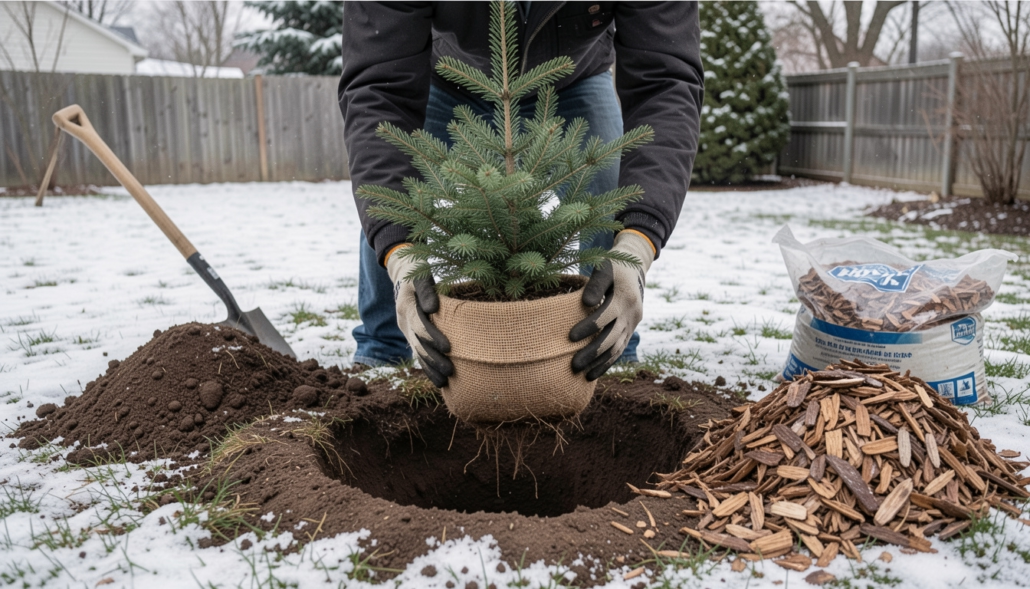
Dig the planting hole now, before the ground freezes. Let the tree adjust in an unheated garage or porch on the way in and again on the way out. Then plant it with the root flare (where the trunk widens into the main roots) level with the ground or slightly above it. In cold areas, you may need to hold the tree until spring.
What should we check before buying a live Christmas tree?
Living trees come two ways. Balled and burlapped trees were dug from a field and have a big ball of soil wrapped in fabric. Container trees grow in pots and are usually small tabletop sizes. Penn State Extension says balled and burlapped trees need to be planted outdoors. Some potted ones aren’t winter hardy, so read the tag before you assume yours can live outside.
Weight surprises a lot of buyers. In a November 23, 2026 column, Purdue Extension educator John Woodmansee writes that a 5- to 6-foot tree with its root ball and soil can weigh 100 to 200 pounds. Line up a helper and a cart or wagon. NC State Extension advises keeping trees meant for the yard no taller than five to six feet.
Pick a species that suits your region. Fraser fir is a popular cut tree, yet NC State doesn’t recommend planting it at lower elevations in North Carolina. For Indiana, Purdue horticulture professor emeritus Michael Dana says in that column that white pine, spruces or white fir make better living trees than Scotch pine. Your local extension office or nursery can tell you what lasts where you live.
Check the mature size, too. An evergreen can grow more than 30 feet tall and 10 to 15 feet wide, so give it a spot well clear of the house and overhead lines. When you’re choosing a tree, Clemson Extension advises looking for:
- Good color with soft, flexible branches
- No brown tips, yellowing or shedding needles
- No signs of pests or disease
- A firm root ball, or for potted trees, moist roots that aren’t crammed in the container
Carry the tree by the root ball or pot instead of the trunk, and set it down gently.
What pest should we look for this season?
Spotted lanternfly egg masses are worth a minute with a flashlight. A Saturday Evening Post nature column from November 2026 explains that tree farmers watch for them, but on rare occasions a tree carrying one reaches a buyer. Fresh masses look shiny and brownish, then turn darker and duller. The column advises scraping them into soapy water.
Penn State’s guide to insects on Christmas trees says to inspect the tree before you move it, so this invasive pest doesn’t travel with it. Check the trunk and branches. If any insects show up indoors, skip the aerosol bug spray. Those sprays are often flammable and shouldn’t be used on a Christmas tree.
When should we dig the planting hole?
Dig as soon as you can, while the soil is still workable. Look for a sunny spot that drains well. Penn State recommends a hole 1 to 2 feet wider than the root ball, with sides that flare outward at the top and a firm, flat bottom. Make it only as deep as the distance from the root flare to the base of the ball. You may need to pull back some burlap or soil to find the flare.
Put the dug soil in tubs or a wheelbarrow and store it in a shed or garage so it doesn’t freeze solid. Illinois Extension also suggests layering 6 to 8 inches of straw over the planting site to keep the ground from freezing deeply. Cover or mark an open hole so nobody steps into it.
How do we move the tree indoors?
Go in stages. A dug tree is dormant, and a gradual move from the cold to a heated room is less stressful for it. Penn State suggests one to two weeks in a garage, shed or sheltered outdoor spot first, if you can manage it. Keep the root ball damp while it waits.
How long can a live Christmas tree stay inside?
Plan on a week at most, and fewer days if you can. Penn State calls four to five days ideal, with one week as the limit. Dana’s advice is tighter, at three to five days. Clemson and the University of New Hampshire Extension allow up to 7 to 10 days. Shorter is the safer choice.
Warmth can wake the tree up. Once it loses its winter dormancy, freezing weather outside can damage or kill it. If you bring the tree in on December 22, aim to have it back in the garage by December 26 or 27. You can still enjoy it with lights on the porch beforehand.
Where should the tree go, and how do we water it?
Choose a cool spot away from direct sun, heat vents, fireplaces and wood stoves. Use LED or other low-heat lights. Turning the thermostat down a few degrees helps slow drying, especially when the room is empty.
Leave the burlap on while the tree is inside. Set the root ball or pot in a watertight tub on about 2 inches of gravel. The gravel lifts the roots out of any water that collects, so they don’t sit soaked.
Check moisture every day. The goal is evenly damp, never flooded. NC State says a full-size tree can use as much as a gallon of water in a day. One handy trick from both NC State and Clemson is to spread crushed ice over the top of the root ball so it soaks in slowly. Keep water well away from light cords and outlets.
How do we plant it after Christmas?
First, move the tree back to the unheated garage or porch for several days. Water it as needed while it readjusts.
Your planting date depends on your climate. Clemson, writing for South Carolina, says to plant as soon as possible and not to wait for spring. New Hampshire’s extension service says the opposite for its colder winters: store the tree in an unheated space, water it now and then, and plant once the soil thaws and dries. If you’re somewhere in between, ask your county extension office. When it’s time to plant:
- Take off the pot, or remove the burlap, wire and twine. Synthetic burlap breaks down poorly and may restrict roots.
- Loosen or cut any roots circling the outside of a potted root ball.
- Set the tree so the root flare sits level with the ground or slightly higher. Planting too deep can harm the bark and eventually kill the tree.
- Refill with the soil you dug out, firming it gently in layers.
- Water well to settle the soil.
- Spread 2 to 3 inches of mulch over the planting area. Straw works, too.
- Stake the tree if the site is windy, taking care not to injure the bark.
How do we care for it the first year?
Evergreens keep losing water through their needles in winter, and new transplants haven’t rooted in yet. That’s why a thorough watering at planting counts. The Purdue column adds that anti-desiccant sprays (coatings that slow water loss from needles) may help.
In spring, water regularly whenever rain falls short. Hold off on fertilizer until the tree starts growing, and go light that first year. Even with careful handling, some living trees don’t survive their first winter.
What if the short indoor stay won’t work for us?
A cut tree is a better fit if you like to decorate for weeks. You could also keep a living tree outside and decorate it there. If you want something that can stay in the house, New Hampshire’s extension service mentions Norfolk Island pine, a tropical evergreen that can live indoors for years with the right light and watering.
For more holiday color indoors, see our guides to forcing amaryllis and paperwhites, keeping a poinsettia alive past January and getting a holiday cactus to bloom.
Live Christmas tree FAQ
Can we leave it up until New Year’s Day?
Only if you bring it in late enough to stay within about a week. A tree that arrives on December 20 and leaves on January 1 has been inside too long to count on it surviving outdoors.
Can we plant a cut Christmas tree?
No. A cut tree has no roots, so don’t expect it to grow if you stick it in the ground. Check whether your town offers tree recycling instead.
What if the ground is frozen and we didn’t dig a hole?
Penn State says you can store the tree in an unheated place and plant it in spring. Without a garage or shed, set it in a sheltered spot out of the wind and mulch around the root ball. Keep checking that it hasn’t dried out.
Are your houseplants looking rough this winter, too? Grab our free Houseplant Rescue Cheat Sheet and keep it handy.
Ginger Durett has more than 10 years of experience as a professional grower, including general growing and medicinal cannabis growing. Blair Sutherland is a co-founder of Happy Healthy Living.

Leave a Reply
Want to join the discussion?Feel free to contribute!