
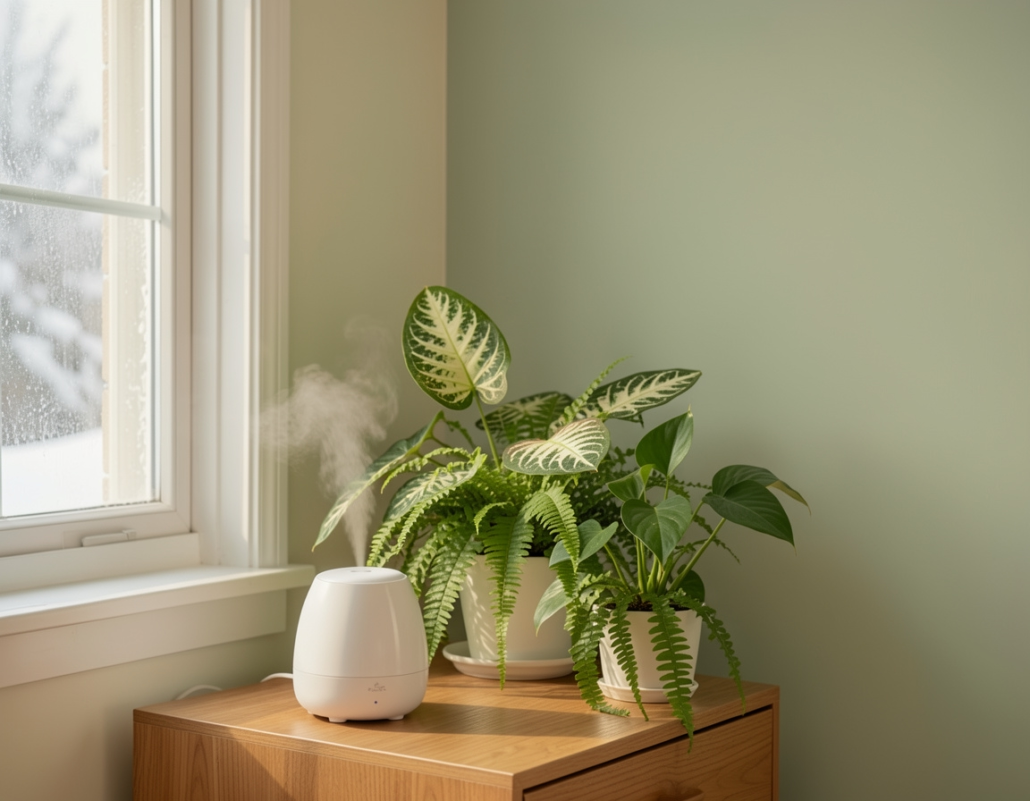
Do Your Houseplants Need a Humidifier in Winter?
This post may contain affiliate links. If you buy through them, we may earn a commission at no extra cost to you.
Brown, crispy leaf tips on a calathea in January, right after you have been careful with the watering, are often a humidity problem rather than a watering one. So do houseplants need a humidifier in winter? For moisture-loving plants such as ferns and calatheas, usually yes. For snake plants and succulents, usually no.
The reason is the air itself. Iowa State University Extension says many houseplants prefer a relative humidity of 40 to 50 percent, while the air in a heated home during winter may sit at only 10 to 20 percent. A humidifier is one of the most reliable ways to close that gap, so if your plants are the thirsty-air kind, it’s worth having one. If they aren’t, you can skip it.
Why winter air is so dry for plants
Cold outdoor air holds very little moisture, and heating a house dries it out further, according to Penn State Extension. Relative humidity is the share of moisture the air is holding compared with the most it could hold at that temperature. ASHRAE, the heating and cooling engineering society, recommends keeping indoor humidity between 30 and 60 percent, and Penn State notes that heated homes can easily fall below 30 percent during the heating season.
Plants lose water through tiny pores in their leaves all the time. When the air is very dry, they lose it faster than the roots can replace it, and the leaf edges are usually the first place it shows.
Which plants need extra humidity and which don’t
A handy rule comes from Justin Hancock, a horticulturist at Costa Farms, in a November 8, 2026 Homes & Gardens article: the thinner the leaf, the more delicate the plant. Fleshy, waxy leaves store water, so those plants cope with dry air better.
Plants Hancock lists as most at risk from dry indoor air:
- Ferns
- Calatheas
- Peace lilies
- Prayer plants
- Ivy
- Polka dot plants
- Nerve plants
Plants that usually handle winter air without help:
- Succulents and cacti
- ZZ plants
- Snake plants
University of New Hampshire Extension puts the general target for most houseplants at 40 to 60 percent, with tropical species preferring 70 to 80 percent. A room humidifier gets you closer to that, and the fussiest tropicals may also do better grouped together or under glass, which we cover below.
What’s new this season: heating, dry air and spider mites
Hancock’s November piece adds a warning that fits this time of year. He says warm, dry air from heating can dehydrate plants, yellow their leaves and set up conditions that pests like. Spider mites in particular reproduce faster once the heat comes on, and he notes that a mite can go from egg to egg-laying adult in about seven days, so a small colony can grow quickly if nobody is watching.
His practical advice is simple. Keep plants out of the direct path of heating vents, and skip the fireplace mantle, however nice it looks. He gives 60 to 75°F as the comfortable range for most plants. We’d add one habit: check the undersides of leaves every week or so for tiny specks or fine webbing, especially on plants that already look dry.
Signs your plants are too dry
Iowa State lists slow growth, dried-up flower buds and brown leaf tips and edges as the results of low humidity. Hancock adds yellowing and crisping leaves. Look for:
- Brown leaf tips and edges
- Crispy, yellowing leaves
- Flower buds that dry up before they open
- Slower growth than usual
None of these points only to dry air. Overwatering, underwatering and low light can cause similar damage, so check the soil first. Our guides to how often to water houseplants in winter and why houseplant leaves turn yellow in winter will help you sort out which cause you’re dealing with.
Do misting and pebble trays work?
Misting is the popular answer, and it doesn’t hold up. Iowa State says humidity rises only for a few minutes after misting, and Penn State says even daily misting does nothing to raise the humidity around a plant. Air plants are the exception, since misting is a normal way to water them.
Pebble trays are less clear. Iowa State lists them as a way to raise humidity near a plant, as long as the bottom of the pot stays above the water. Penn State argues that the evaporated water spreads into the whole room and makes almost no difference to the overall humidity. We’d treat a pebble tray as a small bonus, not a fix.
The bathroom idea sits in the same gray area. Penn State says it depends on how often the shower runs, and that bathrooms often lack enough light for a houseplant. If you want to try it, put a hygrometer in there first.
What actually raises humidity
- A humidifier. Iowa State calls it one of the most reliable options. Penn State says a whole-house humidifier added to a forced-air heating system helps but won’t reach ideal levels for plants, and a portable one is the smaller-scale choice.
- Grouping plants. Water evaporating from the soil and leaves raises the humidity in the nearby air, according to Iowa State. Penn State says how well it works likely depends on how many plants you have and the size of the room.
- Growing under glass. A terrarium or a glass cloche recycles moisture around the plant, per Penn State. Our terrarium guide walks through building one.
- Moving plants away from heat. Radiators, fireplaces and heating vents dry the air around a plant fast.
How to use a humidifier for houseplants
- Measure first. Penn State suggests a hygrometer. Leave a basic one near your plants for a few days. If it reads 40 percent or higher, you probably don’t need a humidifier.
- Place it in the same room. Set it a few feet from the plants, and group the humidity lovers nearby so one unit covers them.
- Aim for 40 to 60 percent. That’s the range the extension services above suggest for most houseplants. If the windows fog up, turn it down.
- Keep the mist off the leaves. Leaves that stay wet invite fungal problems, so point the output away from the plants and keep some air moving in the room.
- Fill and clean it as the maker directs. Follow the cleaning instructions that came with your model.
- Don’t water more. Higher humidity doesn’t mean thirstier plants. Most grow slowly in winter and use less water, and UNH Extension reminds growers to watch for overwatering while they work on humidity.
When you can skip the humidifier
Penn State’s practical conclusion is worth repeating: if the humidity in your home is comfortable for you, your plants should tolerate it through winter, and your effort is better spent on light and watering. If your collection is mostly snake plants and succulents, that’s probably you.
And if your hygrometer reads in range but a few plants still look rough, look at light, temperature and watering next. Our post on indoor plant care during different seasons is a good next stop.
FAQ
What humidity do houseplants need in winter?
Most prefer roughly 40 to 60 percent, based on the Iowa State and UNH guidance above. Tropical plants like it higher, and cacti and succulents tolerate less.
Is misting enough?
No. Both Iowa State and Penn State say the effect lasts only minutes.
Can one small humidifier help a whole room of plants?
It helps the plants closest to it most, which is why grouping them nearby makes sense. A hygrometer will show you whether the room as a whole is improving.
Will a humidifier fix brown leaf tips that are already there?
No. Damaged tips won’t turn green again. Judge the result by new growth, and trim the brown edges if they bother you.
When leaves start to look off and you can’t tell why, our free Houseplant Rescue Cheat Sheet is a handy thing to keep nearby. Sign up and we’ll send it over.
Ginger Durett has more than 10 years of experience as a professional grower, including general growing and medicinal cannabis growing. Blair Sutherland is a co-founder of Happy Healthy Living.


Leave a Reply
Want to join the discussion?Feel free to contribute!